Sunday, May 27th, was the 55th birthday of "Molly" and "Sarah's" beloved Mami (which is the Swiss-German way of spelling Mommy). One day I hope to find out where she has gone and what she is doing, now that Rhode Island has torn away her daughters.
When the girls refused to visit their father, he blamed his wife. She had never wanted a divorce until the girls said how much they feared him. Now that DCYF has given the girls to him in another state -- and washed their hands of it -- I wonder if he allows the children to see their mother at all. Or has she returned to Switzerland to make the "torture" (her children's word for it) less painful for them?
In my years of working with battered women, I have seen many good mothers lose children to abusive ex-spouses. Some mothers went on to accomplish important things--though that was no substitute for raising their own children. Two such stories are told in these books by Dr. Jerri Nielsen at the South Pole:
and by the Peacekeeping Whistleblower Kathryn Bolkovac:
Someday we will learn Mami's story as well.
Today's Providence Journal has this to say (click once to enlarge):
If the Department of Children, Youth and Families (DCYF) is willing to evaluate its own performance in the case of Molly and Sara -- and many other children -- the state must provide a way for us to question this agency with the evidence of abuse by its own staff. We need a genuine process of Truth and Reconciliation to evaluate the way DCYF has abused its power in the past if we are to trust it with such an important job as protecting vulnerable children.
2006
Rhode Island taxpayers have contributed an enormous sum to wage a war that most of us know nothing about. The systems our state established to protect children have instead subjected many to danger and trauma that will profoundly shape the rest of their lives. Who will help to build public awareness and political consensus to protect children from those who prey on them or who profit from their abuse? How should government respond in ways that are transparent and accountable?
Wednesday, May 30, 2012
Sunday, May 13, 2012
Wednesday, April 4, 2012
Healing is a process for survivors of incest
To visit Donna Jenson's website, "What She Knows," and to hear counselors at the Stetson School for Boys tell of the importance of helping children talk about incest, click on the title above, or paste this link in your browser: http://www.timetotell.org/Time_To_Tell.org/Film_Clips.html
Tuesday, February 28, 2012
Dr. DeFrances to speak at COA Conference
"Molly" and "Sara's" supporters, who convened a community-wide meeting in 2006, wrote scores of letters, and met with the Child Advocate to protest DCYF's handling of this case, never succeeded in bringing the girls back home.
But that case prompted the Parenting Project to meet with DCYF and work with legislators to require the Department to get accredited with the Council on Accreditation (COA). We are delighted to learn that DCYF's director, Dr. Janice DeFrances, will speak at COA's National Conference in August.
COA's mission is to partner with human service organizations worldwide to improve service delivery outcomes by developing, applying, and promoting accreditation standards.
For more about COA, go to their website at
www.COAnet.org
Free training webinars are available at
http://coanet.org/training.html
To read the announcement about Dr. DeFrances, click on the title above, or paste this in your browser:
http://hosted.verticalresponse.com/364877/dbdf2b33e4/1471595639/a75e87bcfa/
Tuesday, February 14, 2012
Who is Norbara Octeau?
![]() |
| Norbara Octeau and her mother celebrate Summer Solstice in 2013, nine years after her 2004 decision as administrative hearing officer for DCYF set the stage for Molly and Sara to be taken from their mother into state custody in 2006, kept in foster homes and a state shelter, and eventually turned over to their father's sole custody, despite the girls' graphic drawings and protests against his "sausage games." |
| DCYF headquarters at Friendship Street, Providence. |
Octeau said that she based her decision primarily on evidence presented by Molly's father:
1. printouts of three e-mails and a letter he had written in February 2004;
2. the affidavit of a private investigator he had hired to interview his associates;
3. his testimony; and
4. testimony of DCYF's child protective investigator (CPI) Ann Murphy.
Since the father was the "Petitioner" in this appeal against DCYF, the mother was not considered a party. She and her attorney did not even know of the administrative hearing held on October 12, 2004. Octeau had never seen the woman she vilified in her Decision.
The father and his defense attorney, Lise Gescheidt, attended the hearing, but only one person appears to have represented DCYF:
Child Protective Investigator (CPI) Ann Murphy appeared on behalf of the Department; investigative report #375756 was prepared by CPI Murphy, and references by her in giving testimony at this hearing, but was not offered by the Department as an exhibit. . . . No exhibits were presented by the Department. (Decision, pp. 2-3)
Why did DCYF have no lawyer representing it? And why did DCYF accept Molly's father's emails, letter, and private investigator's report "as full exhibits without objection"--the only exhibits introduced at the hearing?
At this time, DCYF's chief legal counsel, Kevin Aucoin, was responsible to "Enhance communication and problem solving initiatives between the Family Court and DCYF" according to DCYF's "Child and Family Service Plan" (November 2005, p. 52). Parents who turn to DCYF and Family Court to protect their children from abuse complain especially about the role of DCYF's legal department.
![]() |
(Click on photos to enlarge; click "escape" to return to text.) |
Norbara Octeau claimed that this hearing "was held in accordance with the Administrative Procedures Act, R.I.G.L. 42-35-1 Et. Seq. and the Rules and Regulations of the Department for Children Youth and Families" (sic) (Decision, p. 2).
With no one to object, Octeau's Decision set forth fifteen pages of errors, hearsay, and speculation as "Facts" that gained a life of their own. For example, Octeau describes the hotline call that opened the investigation "on or about January 2, 2004" (apparently by a nurse practitioner--though Octeau leaves the caller's identity unclear):
The hotline caller disclosed that the child had been brought to her pediatrician by her mother. . . and while there, the mother had told a nurse practitioner that [her daughter] relayed accounts that the Petitioner came into the child's room at night and exposed himself. (Decision, p. 3)
When I interviewed the mother in 2006, she said she had never reported this to the nurse practitioner or anyone else. The child was always consistent that her father played his "sausage games" during the day when they were home alone, her mother at work and her sister at school, and that these experiences were very upsetting to the child and sometimes physically painful.
So it was irrelevant that the father "denied ever having entered his daughter's room at night to masturbate" or that he "explained that the girls share a very small bedroom and that it would have been impossible for him to have encountered [her] while she was asleep while not also waking his older daughter" (Decision, p. 11).
Octeau's Decision includes warning signs that should have alerted any hearing officer with minimal training in sexual molestation. The father acknowledges to CPI Murphy that he "had been sexually abused by his own father in his native country of Switzerland, and the Petitioner's father had been incarcerated as a result" (p. 3).
(This, too, is inaccurate. The father acknowledged that he and his brothers had been sexually abused by their father. But their father went to prison for abusing disabled boys who were his psychotherapy patients--not for abusing his sons--which apparently remained a family secret. Their father's prison sentence was reported on June 18, 1981.)
In another warning sign that Octeau ignored, CPI Murphy says:
. . . the child had described events with her father using phrases such as "we took a bath together and washed each other all up", "I was in my room playing and Papa came in naked and played with his sausage", "I told him that is not a toy, stop it" and "juice came out of the sausage". [The child] also told the investigator that [she] had complained that "Papa hurt her back and belly and she yelled for her Mom". (p. 4)
Octeau wrote that Murphy "described the child's mimicking of the masturbation act as not something she could have performed unless she had actually witnessed it" (p. 10).
Octeau wrote that the father said he and his daughter "did take a bath together because he wanted to be close to his young daughter" (p. 5, italics added). And that, on the advice of his brother, a lawyer specializing in child sexual abuse, he introduced the concept of "Parental Alienation Syndrome [that] could have accounted for his daughter's disclosure" (p. 14, italics added).
Molly's father had, at first, suggested that either his brother or their father might have molested Molly. The brother, a survivor, and now, a defense lawyer for those accused of sexually abusing children, came to the U.S. to defend his brother. Together they suggested that their father might have molested Molly. Their next line of defense was to blame Molly's mother.
Four years earlier, in 2003, the brother had given Molly's father this article describing the theory of "parental alienation" that blames mothers for coaching their children to accuse fathers of sexual abuse:
Octeau recognizes the Petitioner is on a campaign to find information in his defense on the Internet. She writes that the two brothers' arguments did not persuade the DCYF investigator, the police, or the pediatrician. But she finds them credible.
She focuses on hearsay and speculation that Molly's father presented about his wife and the journals she kept for her children--which the police had examined but did not consider significant.
Nevertheless, without ever seeing the journals herself, Octeau writes:
The journals were apparently a record of information meticulously gathered by the mother about the alleged abuse during the time frame of the investigation. (p. 19, italics added)
The mother had kept journals for each daughter from birth--not to record abuse, but to remind them of good memories.
Instead of insisting on seeing those journals and questioning the wife directly, which Octeau could have done, the hearing officer merely overturned the investigator's finding and made her own remarkable "finding:"
This Hearing Officer finds [the mother's] behavior and conduct . . . to be highly unorthodox and rather suspicious given the marital discontent existing at the time. This maternal behavior casts a shadow over the reliability of the child's statements and, therefore, closer scrutiny of the circumstances surrounding the child's disclosure should have been pursued. (p. 20)
Octeau's Decision offers information that appears ironic in light of the ongoing strategy to vilify Molly's mother. For example, Octeau writes: "CPI Murphy further noted that this multilingual child was hard to converse with because during speech she continually mixed together various languages" (p. 5).
It is easy to comprehend that a traumatized child without even the terminology to describe upsetting sexual behavior would struggle for words. But this, too, became a basis for DCYF staff later to punish Molly's mother whenever she responded to her children in Swiss-German. By then, the entire Department had fallen into line behind Norbara Octeau and seemed to accept the father's defense strategy that his wife used Swiss-German to "coach" the girls against him.
Who is Norbara Octeau? I kept googling her name. In April 2007, I found her online article, "Are the Rhode Island Family Courts against Fathers?"--apparently published to attract fathers to hire her as their divorce attorney
With not even a pretense of judicial restraint, Octeau sarcastically mocks the “pedestal of holy motherhood.” In another article, she writes that mothers’ “traditional roles . . . elevate their argument to a pedestal which still elicits a knee-jerk reaction to the hallowed image of mother and child.”
I sent a copy of her article with a letter to DCYF director Patricia Martinez on April 20, 2007. Nearly five months later, Director Martinez responded. She ignored the question of Octeau's clear bias, offered no evidence of special training, and defended the hearing officer as “a seasoned attorney” who has conducted more than one hundred administrative hearings for the Department.
According to online state payroll records, attorney Norbara Octeau still works as a hearing officer for DCYF. (The average amount paid to 34 DCYF contractors on December 12th, 2011, was $1,387, but Norbara Octeau received $15,437, by far the largest check of all.)
In 2007, Kevin Aucoin responded to the Parenting Project's Access to Public Records request:
DCYF Administrative Hearing Officer Stephen Morris has not sent any further data from his review of the administrative hearing files. The numbers Aucoin provided do not include findings that were expunged from their records after three years. This rule allowed "Molly's" father to win custody of her in 2007.
Reporting on this, the Parenting Project noted that DCYF:
1. fails to track cases of credible sexual molestation;
2. fails to assure that its hearing officers perform their duties in an objective and neutral manner;
3. uses a nationally discredited, unscientific “theory” called “parental alienation syndrome” (PAS) to overturn credible charges of molestation; and
4. works as a team with privately paid contractors (lawyers, assisted by clinicians) who rely on secrecy, delay, and misinformation to win family court custody cases for their clients in ways that harm children.
The Parenting Project's 2007 "Press Advisory" is posted online here:
http://www.thelizlibrary.org/liz/therapeutic-jurisprudence-in-Rhode-Island.pdf
(Paste this in your browser.)
Monday, February 6, 2012
WPRI shows how sex offenders win on appeal
Tim White's story at WPRI reveals the way convicted sex offenders are succeeding in getting Special Magistrate Patrick Burke to reduce their status as sex offenders without ever hearing from the victims of their crimes.
This is exactly what happened in the administrative review process at the Department of Children, Youth and Families when DCYF hearing officer Norbara Octeau overturned the finding against "Molly" and "Sara's" father. (An outline of that case appears at the January 12, 2012, post below, "Eight years ago," with detailed information in prior posts.)
Tim White's story is here (click on the title above, or paste this in your browser):
http://www.wpri.com/dpp/target_12/target-12-sex-offenders-winning-on-appeal
I will post additional documents regarding Norbara Octeau and the bias she revealed.
This is exactly what happened in the administrative review process at the Department of Children, Youth and Families when DCYF hearing officer Norbara Octeau overturned the finding against "Molly" and "Sara's" father. (An outline of that case appears at the January 12, 2012, post below, "Eight years ago," with detailed information in prior posts.)
Tim White's story is here (click on the title above, or paste this in your browser):
http://www.wpri.com/dpp/target_12/target-12-sex-offenders-winning-on-appeal
I will post additional documents regarding Norbara Octeau and the bias she revealed.
Tuesday, January 24, 2012
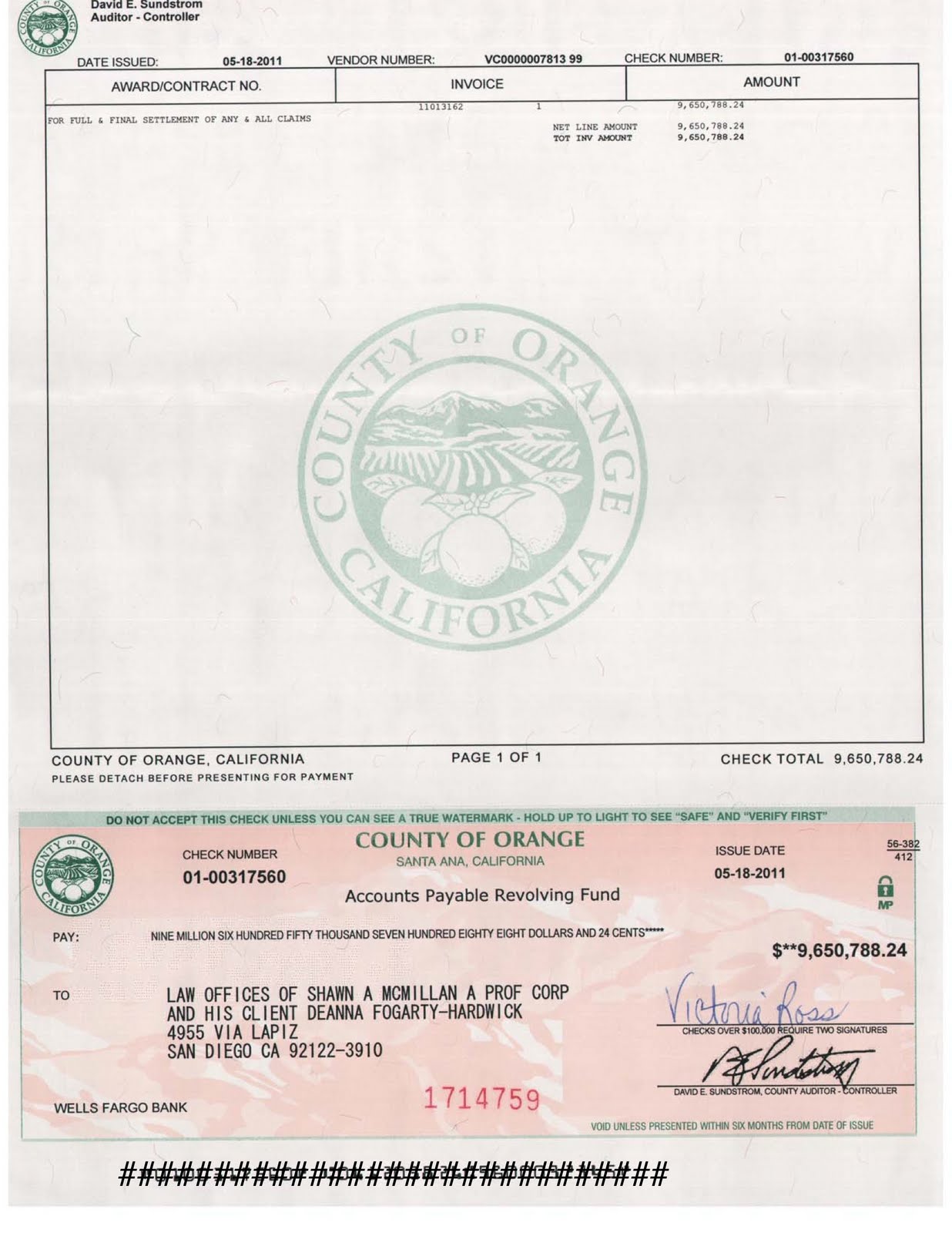
Cost to Orange County, CA, of lying social workers: $10.6 Million
The total cost to Orange County of a case in which a jury found that two social workers lied to take away a woman’s daughters is $10.6 million, according to a new audit.
The U.S. Supreme Court last year declined to hear the county’s challenge to a 2007 jury award of $4.9 million to the Seal Beach woman, Deanna Fogarty-Hardwick. With interest on that amount plus her attorney fees, the total payout by the county was $9.6 million. In addition, the county incurred another $1 million of its own legal costs in the case.
Photo of Deanna Fogarty-Hardwick
For more on the County's response to this award, go to
http://taxdollars.ocregister.com/2012/01/19/cost-to-county-of-lying-social-workers-10-6-mln/146871/
Thursday, January 12, 2012
Eight years ago
Late in 2003, three-year-old "Molly" angrily complained about her father's "sausage games." What the State of Rhode Island did to Molly and her older sister "Sara" in the years that followed outraged their neighbors, who convened a community meeting and asked the Parenting Project to investigate. By 2009, we set a goal that finally began coming to fruition this week, when Governor Lincoln Chafee's new director of the Department of Children, Youth and Families, Janice DeFrances, confirmed that DCYF is beginning an assessment as its first step toward getting accredited.
In 2004, DCYF's frontline staff properly helped Molly and Sara by referring them to counselors at Day One.
When DCYF indicated their father for sexual molestation, his defense attorney appealed. The father first blamed his own father, a psychiatrist and convicted pedophile who had sexually abused his own children. But Molly insisted the offender was her father.
Next, he blamed his wife for "alienating" the girls against him--which did not explain how Molly could re-enact male masturbation and draw a graphic portrait of her father.
A year after Molly's complaint, DCYF's legal department flipped the case at an administrative hearing where the father was the plaintiff, and DCYF was the defendant. Since the girls' mother was not a party to this proceeding, DCYF never informed her of it. She was not present when DCYF's administrative hearing officer ruled that the father was credible, while the mother (whom the officer had neither met nor questioned) was not.
She ruled that the mother's alleged demeanor made Molly's complaint unbelievable. (Over a year later, the hearing officer revealed her own strongly worded bias against mothers on the Internet, where she was seeking men as divorce clients.)
The father's defense attorney's friend became guardian ad litem, who orchestrated the case at Family Court, searching for clinicians who would blame the mother in order to remove the girls from her and their lifelong home in 2006. DCYF sent the girls to a foster mother who told them their mother had mental problems, which was completely untrue.
Distraught there, the girls went to their next foster home and then to a state shelter in another city at enormous expense to tax payers.
The father's defense team needed time--three years until his indication for sexual molestation could be expunged. Finally the Court turned the girls over to their father in another state and limited all contact with their mother.
The DCYF legal department's fear of lawsuits has led the agency to fail many other children. Family Court gives enormous authority to guardians ad litem who have close ties to defense attorneys and judges. The Court's confidence in unreliable psychiatric "evaluations" and its use of gag orders to intimidate protective parents has vastly increased the damage, so that the truth is rarely found within this costly system.
As DCYF begins its process toward accreditation, the General Assembly and Family Court are grappling with entrenched problems throughout Rhode Island's child-protective system.
For more about this, paste this link in your browser:
http://custodyscam.blogspot.com/2012/01/praising-architects-of-change.html
While we honor the leaders who are working on these issues, we also must praise the three-year-old who would not be quiet about the behavior that made her feel so angry and frightened.
In 2004, DCYF's frontline staff properly helped Molly and Sara by referring them to counselors at Day One.
When DCYF indicated their father for sexual molestation, his defense attorney appealed. The father first blamed his own father, a psychiatrist and convicted pedophile who had sexually abused his own children. But Molly insisted the offender was her father.
Next, he blamed his wife for "alienating" the girls against him--which did not explain how Molly could re-enact male masturbation and draw a graphic portrait of her father.
A year after Molly's complaint, DCYF's legal department flipped the case at an administrative hearing where the father was the plaintiff, and DCYF was the defendant. Since the girls' mother was not a party to this proceeding, DCYF never informed her of it. She was not present when DCYF's administrative hearing officer ruled that the father was credible, while the mother (whom the officer had neither met nor questioned) was not.
She ruled that the mother's alleged demeanor made Molly's complaint unbelievable. (Over a year later, the hearing officer revealed her own strongly worded bias against mothers on the Internet, where she was seeking men as divorce clients.)
The father's defense attorney's friend became guardian ad litem, who orchestrated the case at Family Court, searching for clinicians who would blame the mother in order to remove the girls from her and their lifelong home in 2006. DCYF sent the girls to a foster mother who told them their mother had mental problems, which was completely untrue.
Distraught there, the girls went to their next foster home and then to a state shelter in another city at enormous expense to tax payers.
The father's defense team needed time--three years until his indication for sexual molestation could be expunged. Finally the Court turned the girls over to their father in another state and limited all contact with their mother.
The DCYF legal department's fear of lawsuits has led the agency to fail many other children. Family Court gives enormous authority to guardians ad litem who have close ties to defense attorneys and judges. The Court's confidence in unreliable psychiatric "evaluations" and its use of gag orders to intimidate protective parents has vastly increased the damage, so that the truth is rarely found within this costly system.
As DCYF begins its process toward accreditation, the General Assembly and Family Court are grappling with entrenched problems throughout Rhode Island's child-protective system.
For more about this, paste this link in your browser:
http://custodyscam.blogspot.com/2012/01/praising-architects-of-change.html
While we honor the leaders who are working on these issues, we also must praise the three-year-old who would not be quiet about the behavior that made her feel so angry and frightened.
Tuesday, December 13, 2011
Rhode Island needs the Attorney General’s Child Abuse Unit
"Molly" and "Sara" were harmed by Family Court, DCYF, and Hasbro Hospital's Child Protection Program, as well as their father, his legal team, and the court's clinicians. The sisters needed the kind of protection promised by the Attorney General's Child Abuse Unit.
Click on the title above or paste this in your browser:
http://custodyscam.blogspot.com/2011/12/rhode-island-needs-attorney-generals.html
Click on the title above or paste this in your browser:
http://custodyscam.blogspot.com/2011/12/rhode-island-needs-attorney-generals.html
Friday, May 27, 2011
Happy Birthday, Mami!
Today is the 54th birthday of "Molly" and "Sarah's" beloved Mami (which is pronounced the same as Mommy). Although I am not in touch with her, I hope this blog will assure their mother that we will never forget or stop writing about what this country and state did to her and her children.
Today, I want to show a page from the picture book Spontaneous! that includes an entry from Mami's journal and photos of the cakes she made to celebrate her daughters' birthdays. (You can enlarge the page by clicking once on it.)
Lise Iwon has been for many years a close friend of Lise Gescheidt, who was hired by the girls' father to be his criminal defense lawyer--if only Attorney General Patrick Lynch had been doing his job when three-year-old Molly angrily protested her father's "sausage games" in 2003.
The two lawyer friends had no qualms about Iwon serving as Guardian ad litem (GAL) on the case, gouging the boundaries of a role that is supposed to remain neutral. Iwon made direct contact with numerous clinicians and many others, including the Child Advocate. Iwon made no secret of her valued role on the father's defense "team." (Iwon is now president of the Rhode Island Bar Association, and Gescheidt chairs the Rhode Island Supreme Court's Ethics Advisory Panel.)
At one point, Iwon and other women lawyers publicly honored Judge Haiganush Bedrosian with an award as a "role model for women," knowing that she was expected to take over this case if Judge John Mutter recused. (Judge Bedrosian is now Chief Judge of Family Court.)
Iwon oversaw the girls' removal from their mother, home and schools more than five years ago. They were forced to live in foster care and a state shelter and forbidden to communicate with their mother.
I do not know where their mother is today, but I know she is profoundly bereaved. I want to honor her on her birthday by telling her daughters what she often told me before Judge Mutter imposed a gag order on her over three years ago.
She said how amazed she was to hear people complain about their children, because her children were always her greatest joy, and they never gave her any problem at all.
Thursday, April 7, 2011
Five years ago today
On April 7, 2006, Lise Iwon succeeded in removing "Molly" and "Sara" from their mother and life-long home.
The following year, Family Court Judge John Mutter imposed a gag order, threatening further harm to the children if their mother spoke about them or mentioned anything about this custody case-- including its criminal aspects. Consequently, their mother is unable to communicate with me, and I do not know if she and the children are even able to have court-ordered visits.
To date, no one in law enforcement or in the legal community has held anyone accountable for what was done to these children.
Here are two articles that tell part of the history of how that happened:
www.opednews.com/articles/How-lawyers-manipulate-doc-by-Anne-Grant-110327-242.html
http://www.opednews.com/articles/Dr-Gardner-s-ghost-still-by-Anne-Grant-101219-843.html
More is written about the case in this blog and elsewhere.
The following year, Family Court Judge John Mutter imposed a gag order, threatening further harm to the children if their mother spoke about them or mentioned anything about this custody case-- including its criminal aspects. Consequently, their mother is unable to communicate with me, and I do not know if she and the children are even able to have court-ordered visits.
To date, no one in law enforcement or in the legal community has held anyone accountable for what was done to these children.
Here are two articles that tell part of the history of how that happened:
www.opednews.com/articles/How-lawyers-manipulate-doc-by-Anne-Grant-110327-242.html
http://www.opednews.com/articles/Dr-Gardner-s-ghost-still-by-Anne-Grant-101219-843.html
More is written about the case in this blog and elsewhere.
Tuesday, February 8, 2011
Sara's experiences in foster care and a state shelter
We have removed the book Spontaneous! for a while, but we think about "Sara" and "Molly" every day.
Now that Rhode Island's new governor plans to close the state children's shelters and expand foster care, we have been remembering what Sara wrote about her first foster mother, Alice, and how Sara and her little sister were taken into state care at taxpayer expense when they had an outstanding mother, home, friends, and schools.
Some of that true story is in the older posts that appear below.
Now that Rhode Island's new governor plans to close the state children's shelters and expand foster care, we have been remembering what Sara wrote about her first foster mother, Alice, and how Sara and her little sister were taken into state care at taxpayer expense when they had an outstanding mother, home, friends, and schools.
Some of that true story is in the older posts that appear below.
Tuesday, April 6, 2010
Can you believe it?
Four years ago tonight, their mother took these pictures:
"Sara," 9, did her homework. "Molly," 5, planted flower seeds in orange peels.
None of them knew it would be the children's last night at home.
The appalling performance of DCYF in this case and in countless others led to public pressure demanding that this powerful, wasteful, and secretive agency must get accredited. It is long overdue for DCYF to be held to professional standards and public accountability.
Eli H. Newberger, M.D., Assistant Professor of Pediatrics at Harvard Medical School, is a pediatrician with 39 years' experience in the diagnosis, treatment, and prevention of child abuse and neglect. He organized the first child protection team at Children's Hospital Boston, in 1970. He has written:
Learn more about the Council on Accreditation at www.coanet.org . Urge your legislators’ support and follow the progress of this important legislation (H 7133, S 2346) at www.rilin.state.ri.us .
As always, you may send your family's DCYF experiences to me confidentially at parenting project@ veerizon.net
"Sara," 9, did her homework. "Molly," 5, planted flower seeds in orange peels.
None of them knew it would be the children's last night at home. The appalling performance of DCYF in this case and in countless others led to public pressure demanding that this powerful, wasteful, and secretive agency must get accredited. It is long overdue for DCYF to be held to professional standards and public accountability.
Eli H. Newberger, M.D., Assistant Professor of Pediatrics at Harvard Medical School, is a pediatrician with 39 years' experience in the diagnosis, treatment, and prevention of child abuse and neglect. He organized the first child protection team at Children's Hospital Boston, in 1970. He has written:
...the poor performance of some supervisory level staff at the [Rhode Island] Department of Children, Youth and Families is a cause for great concern. In specific cases, I have observed the agency's rigid posture, its ignorance of the standards of professional practice in responding to allegations of child sexual abuse, and its punitive, rather than protective, stance. These rise to a level of intransigence and incompetence unparalleled in all my years of experience in this field . . . .
High, exacting, professional standards do exist in this field. They are attainable by any state that seeks them.
Learn more about the Council on Accreditation at www.coanet.org . Urge your legislators’ support and follow the progress of this important legislation (H 7133, S 2346) at www.rilin.state.ri.us .
As always, you may send your family's DCYF experiences to me confidentially at parenting project@ veerizon.net
Friday, January 1, 2010
Our Goals for 2010
Did Lise Iwon fail in her responsibilities as guardian ad litem in this case? I believe she did. I summarized and documented some of my reasons for this belief in last week’s post.
Whether she did this for cash, cabal, creed, or all three, one thing is certain: A system that sacrifices children so cavalierly will not be reformed without the best efforts of us all, progressives and conservatives alike. All of us must work together to stop the legal stratagems that hurt vulnerable children at DCYF and Rhode Island’s Family Court.
The Parenting Project’s goals for 2010 include these:
1. to require Rhode Island’s Department of Children, Youth and Families (DCYF) to become publicly accountable under accepted professional standards established by the Council on Accreditation (COA);
2. to persuade the Rhode Island Supreme Court to take steps that assure appropriate standards for lawyers, clinicians, and other professionals involved in custody cases, especially where there have been indications of domestic violence, sexual abuse, and coercive control;
3. to prohibit the use of “parental alienation” and other unscientific forms of forensic psychology in making child custody decisions.
Whether she did this for cash, cabal, creed, or all three, one thing is certain: A system that sacrifices children so cavalierly will not be reformed without the best efforts of us all, progressives and conservatives alike. All of us must work together to stop the legal stratagems that hurt vulnerable children at DCYF and Rhode Island’s Family Court.
The Parenting Project’s goals for 2010 include these:
1. to require Rhode Island’s Department of Children, Youth and Families (DCYF) to become publicly accountable under accepted professional standards established by the Council on Accreditation (COA);
2. to persuade the Rhode Island Supreme Court to take steps that assure appropriate standards for lawyers, clinicians, and other professionals involved in custody cases, especially where there have been indications of domestic violence, sexual abuse, and coercive control;
3. to prohibit the use of “parental alienation” and other unscientific forms of forensic psychology in making child custody decisions.
Friday, December 25, 2009
Why did Lise Iwon do it?
The October 2003 issue of The Rhode Island Monthly featured three guardians ad litem (“at law”) in an article called “The Guardians.”[1]
Guardians ad litem often enter a custody case when both parents request a neutral person to represent their children’s “best interests.” But neutrality is rare when a small circle of Family Court lawyers and clinicians rely on friendships and referrals within this closed shop. Free of competition, lax in their rules, and often shielded by confidentiality, they can charge astounding fees in a pay-to-play system that becomes more profitable if it can be stretched out until a child’s 18th birthday.
Since 1996, I have coordinated the Parenting Project, an entirely volunteer effort to research and respond to these disturbing custody cases. We interview people, observe hearings, and study documents from courts, clinicians, children, parents, and the larger community. We analyze how the system works and what reforms are needed. Our goal is to repair a failing government system that traumatizes many families, especially children.
In summer 2006, an op-ed I wrote on the so-called “Parental Alienation Syndrome” [2] brought phone calls from a small town where two young sisters had disappeared amid charges that their mother had “alienated” them against their father. Neighbors denied this allegation and asked the Parenting Project to investigate the case.
By that time, Lise Iwon (above right) had been appointed guardian ad litem even though her close friend Lise Gescheidt was the criminal defense attorney for the girls’ father, who had been indicated by a DCYF investigator for allegedly molesting 3-year-old “Molly” in 2003.
The father’s earliest defense strategy came with photos suggesting that his own father might have molested Molly, for the grandfather had sexually abused his three children. After he became a psychotherapist, he went to prison twice for sex crimes against young patients.
Molly allegedly insisted it was not her grandfather, but her father who molested her. She drew, described, and acted out her complaints about the days when they were home alone.
Her father’s next line of defense was to blame his wife for “alienating” the children against him. Gescheidt brought in private investigator Patricia Azarian to find people who would agree with the father that his wife was “jealous” and “resentful” of him, hoping to sway the administrative hearing officer at DCYF who would rule on the father’s appeal.
DCYF had contracted with private attorney Norbara Octeau to serve as administrative hearing officer though she lacked credentials to rule on child sex abuse cases. In her December 2004 decision exonerating him, Octeau agreed with the father’s theory that his wife had caused “what he termed Parental Alienation Syndrome.”[3]
Though Octeau never met or questioned the man’s wife, she found the woman “highly unorthodox and rather suspicious.” Octeau concluded: “This maternal behavior casts a shadow over the reliability of the child’s statements.”[4]
Psychologist John Parsons examined the family from June to September 2004.[5] But he waited for Octeau’s December 2004 decision, which he used with other reports to complete his January 2005 evaluation, incorporating the same multiple levels of hearsay that Octeau had repeated from the father’s private investigator. Parsons harmonized his views with those and dismissed many troubling comments he had quoted from the girls and their father.[6] Considering the way his conclusions relied on other people’s reports, it seemed ironic that Parsons stopped the girls from seeing their therapists for fear that might contaminate his results.
Lise Iwon entered the case as guardian ad litem in March 2005. Though her role should have been neutral, she made no secret of her teamwork with the defense. Throughout the case, Iwon huddled with the father, his lawyers and DCYF staff, poring over documents in courthouse alcoves.
Attorney Lise Gescheidt defended not only her client, the father, but also her friend, Lise Iwon. Gescheidt accused the mother of introducing motions that “slander the professional reputation of a unbiased guardian ad litem who has consistently acted in the best interest of the children without meaningful compensation….”[7]
When I began researching the case from court files in 2006, the mother provided complete access to family documents and photos. In 2007, my testimony on the case before legislative committees prompted the judge to seal both the divorce and DCYF files, shrouding the case in a gag order.
By then, we had secured all the documents cited here. These show a court record riddled with hearsay and conflicts of interest. From what I could see, the father’s lawyers, DCYF lawyers, and the guardian ad litem appeared to be working in concert to distract attention from Molly’s original complaints against her father and to focus on her father’s campaign of vilification against his wife.
Lise Iwon is a shrewd lawyer, in line to become president of the Rhode Island Bar Association. Before researching this case, I had admired her, in part because I thought she was a progressive.
One early accomplishment of hers occurred on December 4, 1991, when she cross-examined the Family Court’s best known “gun-for-hire,” a term lawyers use for psychotherapists willing to testify in custody courts on behalf of whichever parent pays them.
Psychologist Brian Hayden had reported using Barry Bricklin’s “Perceptual Scale,” to test a five-year-old’s “perceptions of each parent’s skill as a parent.”[8]
Iwon’s questions extracted Hayden’s admission that Bricklin’s test was never scientifically proven to be either valid or reliable and that 75% of the time it favored the “same parent who hired the doctor to administer the test.”[9]
Iwon had skillfully exposed the absurd overreaching of much “forensic psychology” and its recent popularity in custody courts. Ironically that’s the tool she used fifteen years later to remove Molly and Sara from their home and mother on April 7, 2006, when they were 5 and 9 years old, under the pretext that this would be a “temporary” removal for a brief psychiatric evaluation.
Police and DCYF staff went to their schools and took the girls to the first of their foster homes that eventually led to a state shelter where the sisters could not eat together or share the same room.
By separating Molly from her mother and older sister, DCYF attempted to force Molly to recant her accusations against her father in order to “reunite” the child with him. Indeed, Tom Dwyer, then associate director of child welfare at DCYF, informed me that Molly “wants to be with him”--just before they delivered the 7-year-old to her father in August 2007.
The sisters’ year in a state shelter easily cost taxpayers $60,000 in addition to Sara’s two and a half years in foster homes and thousands of hours wasted by state employees and contractors who had been told that the mother had “mental problems.” It was a lie.
Why did Lise Iwon do it?
We may never know why Lise Iwon handled her responsibilities this way. But I suspect it may have been the same three reasons that run like a virus through many domestic violence custody cases: cash, cabal, and creed. Those who examine custody cases should be attuned to all three.
CASH
Iwon’s October 26, 2005, guardian ad litem report on Molly and Sara was slapdash and full of hearsay. She appears to have made no pretense at fulfilling the standards set forth in the training manual, Guardian ad Litem Practice in Rhode Island, that she had helped to write and teach in 2004.
She charged $200 an hour in this case: $1,000 for her single visit to the family’s home, including $400 for time in her car sporting the vanity plate I WON. By April 2006, the girls’ father had paid her over $7,300. Iwon demanded nearly $5,000 more from their mother, who could not pay.
Three days later, Iwon went to court to remove the girls, even trying to prevent their mother from saying good-bye. For that day alone, Iwon added $1,200 to her bill.
Eventually Iwon’s bill would be about $50,000—much of it for time spent seeking and instructing clinicians in a legal stratagem called “parental alienation.”
New Jersey psychiatrist Richard Gardner developed "Parental Alienation Syndrome" around 1985. He advised that sex between adults and children is natural and lobbied against mandatory reporting of child sex abuse. [10] He advanced his ideas through self-publishing and courtroom testimony in hundreds of child custody cases until his suicide in 2003.
Psychologist Barry Bricklin, whose “Perceptual Scale” had embarrassed Brian Hayden under Iwon’s questioning in 1991, became an avid promoter of Gardner’s “parental alienation.”[11]
CABAL
When DCYF subpoenaed me to testify in the closed courtroom on September 7, 2007, Iwon sat with the father’s defense team in the farthest possible seat from the girls’ mother. Not even pretending to be neutral, Iwon identified herself in itemized invoices as a member of what she called the “team,” which she took to its next level by searching for clinicians who would deliver the products that the team needed in court.
She charged $2,400 for her work with licensed clinical social worker Haven Miles, who reported in horrifying detail how she had forcibly “reunited” Molly with her father, even though Miles acknowledged she could not be certain whether he had actually molested the child.[12]
Iwon sought out psychologist Brian Hayden, who met with the older sister for several months. Instead of reinforcing Iwon’s theory, he rejected it unequivocally. Hayden insisted there was nothing sinister about this mother. In fact he praised her as “cooperative, polite,” “articulate, caring,” and “witty.”[13] His report showed this daughter had genuine fear of her father, and Hayden concluded: “I could discern no intent or actions of her mother to influence” the daughter.[14]
Iwon stopped Hayden’s work on the case and turned to Nancy Harper, MD, a Fellow at the Child Protection Program of Hasbro Hospital. From March 27th to April 7th, 2006, Iwon added $1,750 to her bill in a marathon effort to produce yet another lengthy derivative document maligning the mother, repeating the same hearsay from Iwon, Azarian, Octeau, Parsons, Miles, and others while ignoring actual records of the 5-year-old doing and saying things that caused concern to nurses and teachers. Harper accused the mother of “having a toxic effect on the children”[15] and rushed her report to Iwon without getting her supervisor’s signature.
In Iwon’s hands, Harper’s report succeeded in removing the girls from their mother. The process of “reuniting” them with their father would take longer. DCYF could not expunge its original sexual molestation finding against him for three years—late in 2007.
For that, Lise Iwon went to Boston. DCYF director Patricia Martinez told me she had authorized “up to $30,000” (half to be paid by each parent) for a psychiatric analysis of the family. In Boston, Iwon instructed Bernice Kelly, PsyD, MS, RN, at the Law and Psychiatry service of Massachusetts General Hospital and Harvard Medical School. In each of her reports, the psychotherapist wrote that Iwon had raised the question “about the possibility of parental alienation.”[16]
Bernice Kelly proceeded to list the “eight primary symptoms” set forth by Gardner,[17] never realizing that the National Council of Juvenile and Family Court Judges had warned half a year before that this theory does not meet evidentiary standards and should be “ruled inadmissible and/or stricken from the evaluation report.”[18]
Kelly’s colleague, psychiatrist James Beck interviewed each of the girls’ parents and found no evidence of mental disorder in either. He noted that the mother’s “narrative about the alleged sexual abuse is filled with the kind of facts that, in other cases, I have tended to accept as evidence that what is claimed did occur. I have found it difficult in the past to believe that people are able to make up this much concrete detail.” He even acknowledged that “psychiatrists … have no special expertise in detecting lying.”[19]
But Beck accused the mother of a “highly idealized” view of her own childhood while concluding that the father had “compensated well” for his early abuse. The doctor was not as troubled by the father’s “history of gender dysphoria” as he was by his impression that the mother who had lost custody of her children was “a woman on a mission.” Evading the question at the heart of it all, the psychiatrist concluded that he was “glad that others with access to the children, as well as to the parents, have made a determination of the allegations in this case.”[20]
The ease with which Iwon persuaded clinicians to overlook their uncertainties and affirm her hypothesis would seem ludicrous if the court were not so reliant on these “expert” opinions. One judge assured me that the role of the expert is essential in custody cases, for judges have no special training in these matters.
Bernice Kelly’s promotion of “parental alienation” and James Beck’s accommodation to it appear at odds with directors of the Children and the Law Program in Massachusetts General Hospital’s psychiatry department. Andrew Clark, MD, Medical Director, and Robin M. Deutsch, PhD, Director of Forensic Services, have joined other national leaders in opposition to adding Richard Gardner’s hypothesis to the Diagnostic and Statistical Manual of Mental Disorders. [21]
CREED
By promoting the discredited theory of “parental alienation,” Lise Iwon allied herself with the most radical advocates for fathers’ supremacy. I wondered if she might merely be sympathetic with the girl’s father, a childhood victim of incest who had gender-identity struggles.
As chair of the former Women’s Resource Center of South County, Iwon presided over its name-change to the Domestic Violence Resource Center of South County, underscoring the agency’s services to male victims of intimate abuse.
But notions of “parental alienation” and concern about gender issues may have been less compelling for Iwon than the umbrage she takes at Roman Catholicism.
After the initial DCYF finding of sexual molestation forced the girls’ father to leave home in January 2004, the children and their mother began attending church—something he had abhorred. The Catholic Church in their rural town has a group of conservative activists who instantly embraced the mother and daughters. When DCYF and the Family Court removed the girls from their mother 26 months later, these friends started the first wave of letter-writing and fundraising. They convened a community meeting and flew in Richard Ducote, a lawyer who had defended children in dozens of other states. They sought help from the Parenting Project.
During months of drawn-out Family Court hearings, these neighbors faithfully traveled to court with the mother. They paced the marble corridors praying their rosaries like groups have done in demonstrations against Planned Parenthood and gay rights. The similarity would not have been lost on Iwon.
Just six days after “Molly” and “Sara” were taken from their mother, Lise Iwon faced her own bereavement when her good friend Julie Pell died of cancer. Both had been active in causes that I, too, strongly support.
At Pell’s memorial service, Iwon recalled those struggles and recounted their first meeting in 1986:
It was one of the first years the gay rights bill was introduced. We entered the Statehouse where we were all testifying. It was like being at some horrible camp or prison. We were stuck in this hot, cramped place for a really long time subject to intense questions and testimony. We were surrounded by really strange, scary people. And time just dragged on and on. There were bad, really bad, backroom deals going on. And our consciences were shocked. We were personally attacked. It was an intense bonding experience.
Iwon went on to tell of the 1994 "riot" in the Statehouse rotunda:
We were surrounded by anti-gay religious zealots with huge, offensive signs. Julie signaled the riot by setting off a bullhorn. We all followed by blowing whistles and the noise was absolutely deafening. The troopers stormed in, the Christians fled, and I think Julie got stomped on by a state trooper. . . . But we weren’t leaving. No way. We were resolved. [22]
While I value Iwon’s candor in relating that tumultuous encounter, her passion shows one of the reasons she may have lacked the objectivity essential in a guardian ad litem committed to protecting children.
A related sentiment showed up in the online essays of Attorney Norbara Octeau, the administrative hearing officer contracted by DCYF who had overturned the finding against the girls’ father in 2004. In 2007, I found two online essays Octeau had written appealing to fathers to hire her as their divorce attorney. She derided stereotypes of motherhood by evoking an image that Catholics will recognize as their veneration of the Holy Mother:
“It is amazing,” Octeau wrote:
...in today’s modern society that many women revert to touting their traditional roles of cooking, cleaning, laundry and being the tender hands of motherhood to elevate their argument to a pedestal of holy motherhood.[23]In a later article she mocked “the pedestal which still elicits a knee-jerk reaction to the hallowed image of mother and child.”[24]
Breaking through stereotypes, seeking justice
Iwon’s apparent bias, her piling up of hearsay to vilify the mother, her inaccurate portrayal of their home, her failure to interview scores of people who had firsthand knowledge of the family, her deliberate dismissal of experts who disagreed with her—I believe this evidence illustrates severe shortcomings in Rhode Island’s system of child protection.
The reversals of Lise Iwon and Brian Hayden in this case marked a new awareness for me. Victims of domestic violence and sexual assault, along with their advocates, can no longer claim that an “old boys’ club” at Family Court ridicules the concerns of protective mothers. Many professional women have joined that club and are building their careers as domestic violence deniers.
As a retired pastor and former executive director of Rhode Island’s largest and oldest shelter for battered women and their children, I have worked closely with scores of mothers—some good, some bad, and many in the middle. The mother in this case is extraordinarily good. The drumbeat of vilification against her focuses full attention on the worst failures in our system.
I have written more about the case in other places, including a little picture book called, Spontaneous!
http://www.blurb.com/bookstore/detail/1119986
and in later publications, such as a chapter in
http://www.civicresearchinstitute.com/dvac.html
and an article in
http://www.civicresearchinstitute.com/online/article_abstract.php?pid=6&aid=3038&iid=445&page=3
Anne Grant, ParentingProject@verizon.net
NOTES:
As always, if I have made any errors in this account, I welcome corrections at parentingproject@ verizon.net
--Anne Grant
[1] M.E.Reilly-McGreen, “The Guardians,” The Rhode Island Monthly (Oct. 2003), 54 ff., photo by Dana Smith.
[2] Anne Grant, “Family Court Devastation: Discredited ‘Parental Alienation Syndrome’,”
Providence Journal (June 27, 2006) B5.
[3] Norbara L . Octeau, “Decision,” DCYF Administrative Hearing AH/04-55 (stamped Dec. 20, 2004) 14.
[4] Octeau, 20.
[5] Lise M. Iwon, “Guardian ad Litem’s First Report,” October 26, 2005: 3.
[6] John P. Parsons, PhD, “Psychological Assessment/Sexual Offender Evaluation,” January 8, 2005 (incorrectly marked 2004).
[7] Lise J. Gescheidt, “Objection to Mother’s Motion to Allow Further Evaluations of Minor Children,” Juvenile Case No 2006-0882-01, 2006-0882-02, April 13, 2007: 4.
[8] Brian Hayden, PhD, “Psychotherapy Summary,” (F.C. File No. W88-0590), Oct. 28, 1991: 2.
[9] Partial Transcript (F.C. No. W88-0590), Dec. 4, 1991: 53.
[10] Stephanie J. Dallam, “Dr. Richard Gardner, A Review of His Theories and Opinions on Atypical Sexuality, Pedophilia, and Treatment Issues,” (2005). http://www.leadershipcouncil.org/1/res/dallam/2.html
Joan S. Meier, “Parental Alienation Syndrome and Parental Alienation: Research Reviews,” Applied Research Forum (Jan. 2009) http://www.leadershipcouncil.org/docs/VAWnet.pdf
The Leadership Council on Child Abuse and Interpersonal Violence, “Overview of Dr. Richard Gardner’s Opinions on Pedophilia and Child Sexual Abuse” (2005). http://www.leadershipcouncil.org/1/pas/RAG.html
[11] On December 1, 2009, the Federal Trade Commission promulgated new rules to stop the “false, misleading and unsubstantiated claims” that Bricklin and others were making for the mail-order “Rotation Diet” he had developed in 1985--a year after his “Perceptual Scale,” and at the same time that Gardner was perfecting his “Parental Alienation Syndrome.”
http://rachel-foundation-lawsuit.com/images/Bricklin_charged_by_FTC.pdf
http://www.carbrotationdiet.com/affiliate-policy.html
[12] Haven Miles, MSW, LICSW, “Summary of Contacts, Parent-Child Assessment,” Nov.
28, 2005: 4-5.
[13] Brian Hayden, PhD, “Psychological Evaluation,” Jan. 5, 2006: 1.
[14] Hayden 3-4.
[15] Nancy S. Harper, MD, Fellow, Child Protection Program, 1676-86-32 AC 000110906231, April 5, 2006: 13.
[16] Bernice Kelly, PsyD, MS, RN, “Status Report” (N20040106),” Oct. 22, 2006: 2. Kelly noted Iwon’s concern about “parental alienation” in her subsequent reports on Jan. 11, 2007: 2 and March 6, 2007: 2.
[17] Bernice Kelly, “Status Report” (N20040106),” January 11, 2007: 6.
[18] National Council of Juvenile and Family Court Judges, Navigating Custody & Visitation Evaluations in Cases with Domestic Violence: A Judge’s Guide, 2006: 24. NCJFCJ's spiral book with laminated "bench cards" to assist judges describes the same process I believe Iwon used in this case, even highlighting the term in their Guide: “One common flaw in reports prepared by custody evaluators…is 'confirmatory bias'…. When the evaluator develops a hypothesis—forms an opinion about some issue in the case—early in his or her process, finds data to support it, confirms the hypothesis, and then stops testing it against new or different data…,” 25. These cautions are repeated in NCJFCJ's A Judicial Guide to Child Safety in Custody Cases (2009), available online at
http://www.ncjfcj.org/images/stories/dept/fvd/pdf/judicial%20guide.pdf
[19] James Beck, MD, as cited by Bernice Kelly, PsyD, MS, RN, “Status Report,” March 6, 2007: 4-5.
[20] Beck, cited by Kelly: 5.
[21] Janet R. Johnston, PhD, and Joan B. Kelly, PhD, et al, letter to Daniel Pine, MD, Chairman of the Disorders in Childhood and Adolescence Work Group for the Diagnostic and Statistical Manual of Mental Disorders, Fifth Edition, October 12, 2009.
[22] Quoted from “Gay Rights Leader Julie Pell Remembered” by Peter Cassels, Edge Boston, Thursday Apr 20, 2006: http://www.edgeboston.com/index.php?ci=108&ch=news&sc=glbt&sc2=news&sc3=&id=11760
[23] Norbara L . Octeau & Christopher A . Pearsall, Rhode Island Divorce Lawyer Tips for
You–Are the Rhode Island Family Courts against Fathers? http://www .rhodeislanddivorce-
tips .com/2007/02/rhode_islanddi_12 .html . Mr. Pearsall’s name was later removed from this posting, and another article by Octeau was substituted. Both articles reveal similar hostility to mothers.
[24] Norbara L . Octeau, “DCYF Children Abuse/Are the Rhode Island Family Courts against fathers?”
(Feb . 20, 2007), http://rhodeislanddivorcetips .typepad .com/dcyf_children_abuse/2007/02/
are_the_rhode_i .html
Wednesday, November 4, 2009
Patrick Lynch builds his war chest, Part 2
A current custody case shows Attorney General Patrick Lynch's strange priorities in allocating Rhode Island's scarce resources for prosecuting criminals. His office assigned two Special Assistant Attorneys General, Daniel Carr Guglielmo and Peter Roklan, as prosecutors in a case that should never have come to criminal trial at taxpayer expense. At least a half dozen men entered the courtroom at various times yesterday and today, seeming to advise the two young attorneys. Moments before the trial, one assured them: "I'm here for you."
Why was this case so important to Lynch?
Today, November 4, 2009, a Superior Court jury threw out the disorderly conduct charges that Lynch's prosecutors tried to pin on a toddler's mother in a tumultuous divorce and custody case. Finding the mother not guilty took the jury less than an hour.
Jury members never learned the backstory to the case that began when the baby's father came home from work on March 1, 2007, packed his clothes, and took their son to his sister's home. Just one year old, the baby was still nursing. When his mother went to her sister-in-law's house searching for her son, a fight ensued, leaving the baby's mother with a broken nose. Police came and arrested the mother.
Nor did jury members learn about the spate of harassing phone calls allegedly made by the husband, his sister and mother, or the numerous charges instigated, not only against his wife, but against her mother and stepfather--each one a costly ordeal for his wife's family to fight in various courts.
This kind of persistent litigation, dragging a civil case into numerous criminal courts, is a strategy we have come to call domestic violence by proxy.
In this case, the ongoing harassment led to the baby's mother being repeatedly imprisoned on spurious charges, losing not only her child, but her 13-year career as a social worker at DCYF. Prison clinicians diagnosed her with post traumatic stress disorder, and townspeople told me that his stalking and lying about her still continue.
Only two months ago, Special Assistant Attorney General Peter Roklan was at another courthouse trying to get her imprisoned again. To read more about that incident see
http://writingtruthtopower.blogspot.com/2009/01/verbatims.html
Yesterday, Superior Court Judge Gilbert Indeglia briefly excused the jury while defense attorney Jeffrey Pine, himself a former Attorney General, moved for acquittal. He argued that the evidence presented by the state's witnesses fell far short of the legal requirements for disorderly conduct.
The jury never saw the odd performance by Special Assistant Attorney General Guglielmo, who vehemently jabbed his finger again and again at the defendant, inches from her face, as he stammered with vitriol that she had uttered a profanity and threat in the corridor of Family Court. She had plenty of motive to threaten her husband's girlfriend, Guglielmo exclaimed, for she probably did not like the woman's testimony that day.
Judge Indeglia interrupted the young attorney's aggressive behavior and questioned his assumption, but also denied Pine's motion. Later the judge would instruct the jury clearly in the legal requirements for finding someone guilty of disorderly conduct.
Prosecuting attorney Roklan admitted to the jury: "We can all agree" that the man behind the whole ordeal "is a bad person" who "lies" and "cheats" and "uses" people. Still Roklan urged them to believe the testimony that his now ex-wife had been guilty of disorderly conduct against his now former girlfriend.
By noon on their second day, the jury returned, filing past the defendant, Attorneys Pine, Guglielmo, and Roklan. All four stood in a formal sign of respect. Jury members had been unfailingly serious before, but now they smiled. They had reached unanimous agreement: The accused ex-wife is not guilty.
As in other heavily litigated domestic violence cases I have witnessed, Superior Court juries have a gift for promptly concluding matters that would escalate into a vicious, ongoing game of cat-and-mouse at Family Court.
It is hard to fathom why this case matters so much to Attorney General Patrick Lynch except perhaps that the little boy's father hired a well-connected attorney, Scott Partington, who happens to be his town's municipal court judge and husband of Assistant Attorney General Rebecca Partington and son of a legend in Rhode Island law enforcement, the late John Partington.
In stark contrast to Patrick Lynch, Jeffrey Pine's years as Attorney General brought significant progress to Rhode Island in addressing the crime of domestic violence that places a huge burden on private citizens and public funds.
Mr. Lynch's term in that office has tipped the balance back to abusers who become obsessed with using police, judges and state's attorneys to further their own private campaigns--getting the state to drain its low resources on frivolous cases that commit domestic violence by proxy.
Why was this case so important to Lynch?
Today, November 4, 2009, a Superior Court jury threw out the disorderly conduct charges that Lynch's prosecutors tried to pin on a toddler's mother in a tumultuous divorce and custody case. Finding the mother not guilty took the jury less than an hour.
Jury members never learned the backstory to the case that began when the baby's father came home from work on March 1, 2007, packed his clothes, and took their son to his sister's home. Just one year old, the baby was still nursing. When his mother went to her sister-in-law's house searching for her son, a fight ensued, leaving the baby's mother with a broken nose. Police came and arrested the mother.
Nor did jury members learn about the spate of harassing phone calls allegedly made by the husband, his sister and mother, or the numerous charges instigated, not only against his wife, but against her mother and stepfather--each one a costly ordeal for his wife's family to fight in various courts.
This kind of persistent litigation, dragging a civil case into numerous criminal courts, is a strategy we have come to call domestic violence by proxy.
In this case, the ongoing harassment led to the baby's mother being repeatedly imprisoned on spurious charges, losing not only her child, but her 13-year career as a social worker at DCYF. Prison clinicians diagnosed her with post traumatic stress disorder, and townspeople told me that his stalking and lying about her still continue.
Only two months ago, Special Assistant Attorney General Peter Roklan was at another courthouse trying to get her imprisoned again. To read more about that incident see
http://writingtruthtopower.blogspot.com/2009/01/verbatims.html
Yesterday, Superior Court Judge Gilbert Indeglia briefly excused the jury while defense attorney Jeffrey Pine, himself a former Attorney General, moved for acquittal. He argued that the evidence presented by the state's witnesses fell far short of the legal requirements for disorderly conduct.
The jury never saw the odd performance by Special Assistant Attorney General Guglielmo, who vehemently jabbed his finger again and again at the defendant, inches from her face, as he stammered with vitriol that she had uttered a profanity and threat in the corridor of Family Court. She had plenty of motive to threaten her husband's girlfriend, Guglielmo exclaimed, for she probably did not like the woman's testimony that day.
Judge Indeglia interrupted the young attorney's aggressive behavior and questioned his assumption, but also denied Pine's motion. Later the judge would instruct the jury clearly in the legal requirements for finding someone guilty of disorderly conduct.
Prosecuting attorney Roklan admitted to the jury: "We can all agree" that the man behind the whole ordeal "is a bad person" who "lies" and "cheats" and "uses" people. Still Roklan urged them to believe the testimony that his now ex-wife had been guilty of disorderly conduct against his now former girlfriend.
By noon on their second day, the jury returned, filing past the defendant, Attorneys Pine, Guglielmo, and Roklan. All four stood in a formal sign of respect. Jury members had been unfailingly serious before, but now they smiled. They had reached unanimous agreement: The accused ex-wife is not guilty.
As in other heavily litigated domestic violence cases I have witnessed, Superior Court juries have a gift for promptly concluding matters that would escalate into a vicious, ongoing game of cat-and-mouse at Family Court.
It is hard to fathom why this case matters so much to Attorney General Patrick Lynch except perhaps that the little boy's father hired a well-connected attorney, Scott Partington, who happens to be his town's municipal court judge and husband of Assistant Attorney General Rebecca Partington and son of a legend in Rhode Island law enforcement, the late John Partington.
In stark contrast to Patrick Lynch, Jeffrey Pine's years as Attorney General brought significant progress to Rhode Island in addressing the crime of domestic violence that places a huge burden on private citizens and public funds.
Mr. Lynch's term in that office has tipped the balance back to abusers who become obsessed with using police, judges and state's attorneys to further their own private campaigns--getting the state to drain its low resources on frivolous cases that commit domestic violence by proxy.
Saturday, September 19, 2009
Patrick Lynch builds his war chest, Part 1

Attorney General Patrick Lynch has been making personal phone calls, reaching out to prospective donors, building his war chest to run for Governor of Rhode Island in 2010.
Potential donors need to understand how Lynch and his office have failed children held hostage by Family Court, including those I’ve called “Molly” and “Sara” in the Little Hostages blog.
After DCYF’s child protection investigator made a finding that indicated Molly’s father for sexual molestation in 2004, Attorney General Lynch did not convene a grand jury to consider the evidence. Why not?
I interviewed the town police chief who originally handled Molly’s case. Based on his experience, he told me that he believed Molly’s father could not have passed a lie detector test. Nevertheless the Attorney General’s office considered Molly, at 3, “too young” to make a credible complaint of sexual abuse.
But it is well known that children three and younger are especially vulnerable to sex crimes by family members.
Rhode Island children would be better protected from criminal acts within their own homes if Attorney General Lynch worked to assure that these children will no longer be subjected to scores of examinations by one stranger after another, including many whose reports show them to be unqualified, biased, or simply inept with children.
Some counseling agencies, like Day One, have state-of-the-art interview rooms, where a skilled interviewer who relates well to children can help a child disclose traumatic information. A multidisciplinary forensic team can observe the interview on a monitor in a separate room. They can communicate their questions discretely through the interviewer. A DVD of the interview can be made available for grand jury or judge. The recording provides a confidential record so evaluators can steadily improve the performance of interviewers and the integrity of the process.
These DVDs could reassure judges who fear that some interviewers may predispose children to allege crimes that never happened. Where sexual abuse did occur, the value of preserving the child’s first description of a crime is clear. Spontaneous words, gestures, and drawings of young children, unmediated by adults, are often compellingly vivid.
Molly’s energetic reenactment convinced the investigator. But that evidence was not videotaped. DCYF met with the accused father and his defense attorney, buried the investigator’s written report, and hired an administrative hearing officer who overturned the finding that indicated the father had molested his daughter. The same hearing officer revealed extreme personal bias against mothers in her written decision and in her online essays appealing to men to hire her as their divorce attorney.
Neither DCYF nor the Attorney General acknowledged these failings. In 2006, DCYF removed Molly from a mother who had been uniformly praised in scores of letters from neighbors and colleagues. Sixteen months later, in 2007, DCYF took Molly from a state shelter and gave her to the very man she had so vigorously accused.
Our top law enforcement officer should understand the need to collect evidence early and thoroughly in a prescribed process that can be evaluated and perfected. There is no need to subject a child to repeated grilling by countless adults—as was inflicted on Molly and many other children who have suffered enormously at the hands of the state.
Constant repetition quickly makes a child sound rehearsed, giving rise to allegations that the child has been “coached” to lie by the other parent. A victimized child soon grows anxious and despondent and may refuse to talk altogether.
In 2009, Phil West and I met with Attorney General Lynch and his staff to discuss these ongoing concerns. Lynch seemed unfazed by the problem and entirely self-satisfied. He said his staff participates in regular team meetings to consider cases like Molly’s. While insisting that DCYF, not the Attorney General, is responsible for crimes against children at home, one of Lynch’s top staff stated with absolute confidence that “we have the best criminal justice system in the world.”
The rest of the world is not so sure. In 2007, the national child rights organization, First Star, issued its report card showing Rhode Island earned only 25 points out of 100, scoring the lowest of all fifty states, for our failure to assure vulnerable children adequate legal representation:
http://www.firststar.org/documents/FIRSTSTARReportCard07.pdf
When Rhode Island’s Child Advocate Jametta Alston and the national organization Children’s Rights renewed their class action suit against DCYF one month ago, they were joined by sixteen children’s legal aid organizations, law school clinics, and child advocacy experts from across the country:
http://www.childrensrights.org/news-events/press/broad-national-coalition-of-child-welfare-advocates-and-experts-line-up-in-support-of-rhode-island-reform-class-action/
Rhode Island’s Attorney General has failed to protect these children. Instead of helping Patrick Lynch become Governor, consider how he has placed Molly, Sara, and other vulnerable children in far greater danger through his actions and failures to act as Attorney General on their behalf.
We have been researching some of those cases for future posts.
Wednesday, September 16, 2009
2009 books on sex crimes against children

Our extended family includes a convicted pedophile. This year, under an assumed name, he published his memoir, in which he describes his obsessive search for friends, jobs, and travel destinations that gave him sexual access to young boys, much like “Molly” and “Sara’s” paternal grandfather.
Both men went to prison for these crimes--but not for their crimes against children in their own families. (An editor removed accounts of incest from our relative’s book, apparently because these “complicated” his story.)
http://www.amazon.com/Made-USA-Memoir-Sex-Offender/dp/1887650504
The late Richard Gardner, psychiatrist, author, and self-publisher, created “Parental Alienation Syndrome” in 1985 and built it into a cottage industry. He lobbied against mandatory reporting of sex crimes against children. He argued that society was too restrictive when it prohibits sex between adults and children.
His theory held that children who complain of abuse by their fathers should not be believed, since their mothers had probably alienated, brainwashed, and coached them to lie. These children, Gardner advised, should be taken from their mothers and awarded to their fathers.
"Parental alienation" was the false pretext used to removed "Molly" and "Sara" from their mother in order to "reunify" them with their father.
The National Council of Juvenile and Family Court Judges has emphatically rejected “Parental Alienation” for failure to meet evidentiary standards. But Rhode Island’s Family Court has groomed psychologists who actively promote it.
This year, some superbly written books have been published that challenge pedophile assumptions:

Lost Paradise: From Mutiny on the Bounty to a Modern-Day Legacy of Sexual Mayhem, the Dark Secrets of Pitcairn Island Revealed
Journalist Kathy Marks tells of a historically Christian society where men routinely raped and assaulted children while women acquiesced on the Island of Pitcairn that was settled more than 200 years ago by mutineers. Marks went to the remote island in 2004 to report on the trials of village leaders and others for raping children. She provides an astonishing account of this sexually permissive criminal culture and some of its profoundly disturbing consequences.
http://www.amazon.com/Lost-Paradise-Modern-Day-Pitcairn-Revealed/dp/1416597441/ref=sr_1_1?ie=UTF8&s=books&qid=1253114284&sr=1-1

Unspeakable: Father-Daughter Incest in American History
History Professor Lynn Sacco meticulously documents centuries of denial, steeped in class, race, and gender, that refused to prosecute white fathers for incest. She describes the manipulation of medical evidence to shore up patriarchal power at the expense of girls’ physical and emotional integrity. With concern for their own careers, otherwise progressive professionals have preferred to help defense attorneys "detect ‘malicious prosecutions’ and false allegations" rather than reporting actual medical evidence of abuse.
http://jhupbooks.press.jhu.edu:80/ecom/MasterServlet/GetItemDetailsHandler?iN=9780801893001&qty=1&source=2&viewMode=3&loggedIN=false&JavaScript=y

Tempest in the Temple: Jewish Communities and Child Sex Scandals
Sociologist Amy Neustein exposes collusion between a district attorney and council of rabbis intent on suppressing sex abuse allegations against yeshiva administrators, therapists, and rabbis. In 2000, a Yiddish-language newspaper in Brooklyn, NY, published a full-page notice signed by fifty prominent rabbis reminding readers of the “severe prohibition” against informing non-Jewish authorities against another Jew. This includes reporting child abuse to police. The record shows similarities to the Catholic Church's history of covering up sexual abuse of children by priests.
http://www.upne.com/1-58465-671-9.html

My Body Belongs To Me
Assistant District Attorney Jill Starishevsky prosecutes sex crimes against children in New York City. Her book uses simple words in readable rhymed verse to give young children a sense of ownership over their bodies. If an adult touches them in ways that scare them, they can tell parents or teachers. “He said it’s our secret/ and told me not to tell./ But I ran away real fast/ and then began to yell.” Sara Muller has illustrated the book with expressively whimsical drawings to help children understand their personal right to feel safe and respected.
http://www.mybodybelongstome.com/

Angela Shelton’s Warrior Workbook
Filmmaker Angela Shelton, who escaped childhood incest along with her siblings, has designed a therapeutic step-by-step journal that she subtitles “Be your own hero" with the reminder: "It’s never too late to have a happy childhood.” Her outspoken humor is healing and smartly illustrated by James Murray. Disarmingly clown-like and powerful, Angela’s infectious, can-do spirit and spontaneity help the wounded to take heart and find their unique voices.
http://store.searchingforangelasheltonstore.com/swordwb.html
Subscribe to:
Posts (Atom)
AddThis
Blog Archive
About the Author & Purpose
Parenting Project is a volunteer community service provided since 1996 by Mathewson Street United Methodist Church, Providence, RI, to focus on the needs of children at risk in Family Court custody cases. The coordinator, Anne Grant, is a retired United Methodist minister and former executive director of Rhode Island's largest shelter and service agency for battered women and their children. We research and write about official actions that endanger children and the parents who are trying to protect them. Our goal is to reform this area of government and to establish an effective, transparent and accountable child protective system.
We first reported on this case at http://custodyscam.blogspot.com/
To read the blog more easily, please reduce the width of your column. Some of the pictures can be enlarged by clicking once on them.
We first reported on this case at http://custodyscam.blogspot.com/
To read the blog more easily, please reduce the width of your column. Some of the pictures can be enlarged by clicking once on them.
Comments and corrections may be sent in an email with no attachments to parenting project @ verizon.net
About "Parental Alienation"
If you are not familiar with Richard Gardner's theory of "parental alienation" and how it is being used in custody courts, scroll down to the earliest posting, "Junk Science in Custody Courts." For more scholarly research, visit http://www.leadershipcouncil.org/1/pas/1.html
For more on the scandal in custody courts, see:
http://www.centerforjudicialexcellence.org/PhotoExhibit.htm
For more on the scandal in custody courts, see:
http://www.centerforjudicialexcellence.org/PhotoExhibit.htm